

Legislation: In May 2025, Senator Cindy Hyde-Smith (R-MS) introduced the Buying American Cotton Act (S. 1919). Representatives Greg Murphy (R-NC) and Terri Sewell (D-AL) introduced a companion bill in the House (H.R. 7230) in January 2026.
Objectives: By leveraging the traceability of U.S. cotton and the purchasing power of U.S. consumers, the Buying American Cotton Act (BACA) authorizes transferable tax credits to incentivize the consumption of
U.S. cotton and U.S. cotton manufactured products. The program brings about a stronger linkage between the cotton purchased by U.S. consumers and the cotton produced by U.S. farmers.
Eligible Articles: Cotton products, including but not limited to apparel, home textiles, and nonwovens, either fully manufactured in the United States or imported into the United States, that are made in whole or in part from U.S. extra-long staple cotton or upland cotton.
Eligible Taxpayer: The first U.S. entity who sells an eligible article in the United States in its final condition, meaning the product is now “ready for sale” at retail to the consumer. The taxpayer may claim the credit based on the value of the U.S.-grown cotton in the eligible article, or instead, may elect to claim a higher-value credit based on the value of the U.S.-manufactured yarn or the U.S.-manufactured fabric, if the taxpayer can demonstrate the eligible article was made from U.S.-manufactured yarn or fabric, respectively.
Documenting the Use of U.S. Cotton: Entities claiming the tax credits must be able to demonstrate proof of U.S. origin through a trustworthy supply chain tracing system that certifies the provenance and volume of the cotton in the eligible article, or of the yarn or fabric if either of those credit options are selected.
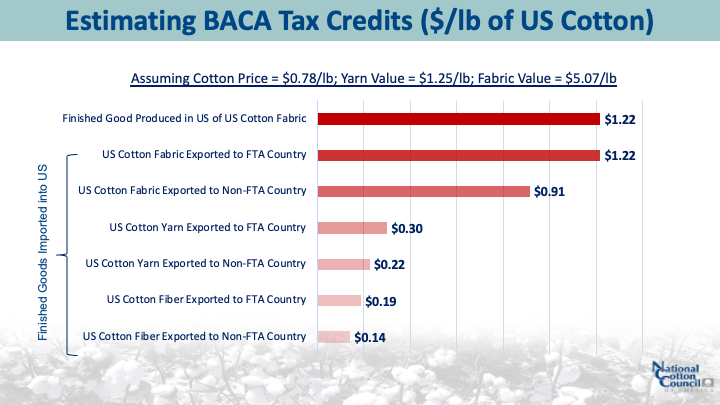
Calculation of the Tax Credits: The value of the tax credit is determined as the product of the volume of U.S.-grown cotton in the eligible article and a factored percentage of the rolling three-year average market price. If the taxpayer elects a credit based on U.S.-manufactured yarn, the value is multiplied by a price factor of 1.6, and for U.S.-manufactured fabric, multiplied by a price factor of 6.5, to incentivize and reward the consumption of U.S.-manufactured goods.
Factors Determining the Value of the Tax Credits: In the case of an eligible article that is processed either wholly in the United States or in a country or countries with which the United States has entered into a free trade agreement or for which the United States has extended benefits through a preferential trade arrangement, a location factor of 24% is used. In the case of an eligible article that was subject to processing at any stage in any other country, a location factor of 18% is used.
Tax Credit Formula: The per-pound value of the tax credit is determined by the formula:
= (3-Yr Average Cotton Price) * (Price Factor) * (Location Factor)
Impacts of BACA
- Availability of tax credits will incentivize brands/retailers to specify U.S. cotton in their supply chain
- Builds on traceability of responsibly grown U.S. cotton
- Tax credits will spur additional demand for U.S. cotton as brands/retailers shift from other cotton growths and adjust fiber mix to lessen use of synthetic fibers
- Reducing synthetic fiber use helps address microplastics
- Tiered tax credits support U.S. textile manufacturing
- Increased yarn and fabric production by the U.S. textile industry will be exported to CAFTA-DR and USMCA countries, further strengthening near-shoring supply chains
- Each dollar of cotton value at the farm gate is estimated to produce total economic activity of 15:1
- Support rural communities, local lending institutions and employment across the cotton industry
- Increased economic activity results in additional taxes paid by companies in the raw cotton supply chain
- As demand increases, stocks/use ratios tighten, providing support to cotton prices and savings in farm bill programs
- BACA tax credits increase exports of U.S. cotton fiber as international mills demand U.S. cotton
- Increased exports of U.S. cotton fiber, yarn and fabric have a positive impact on the U.S. trade balance
- U.S. cotton production increases in response to stronger market signals, resulting in additional economic activity across the raw cotton supply chain